Sunday, 16 November 2014

Production Log 6

Opening sequences are a key introduction to any film, and there are 16 key conventions in an opening sequence to any film genre, not just BSR films.

Brian Grazer, producer of 8 Mile.
  • Super Imposed Graphics: These graphics are overlayed on the scenes/shots in an opening sequence. And almost always contain film crew, actors names and production companies.
  • Production Company: This tells the audience who made the film, and who supplied the cameras, sets, runners and general things needed to fully make a film. The production company is usually  a super imposed graphic at the very start of an opening sequence, as they need to be credited just as much as the distributor logo.
  • Producers: The producers of the film control the budget, so how much the production companies aim to spend, and still make a profitable film. 
  • Director: A director is the join most creative person in film making, they work constantly aside the writer to create what the writer has visioned on paper, and their passion helps the film to become visual. Directors usually get the most credit for a a film.
  • Actors: The main actors are introduced by name, usually on a scene where there charachter is being explored. This gives them credit for persuing their charachter role.
  • Engaging Music: This draws the audience in to the film, and usually reflects the themes explored in the film. 
  • Minimal Dialogue: This is used to explore the setting, and charachters in an opening sequence, by not having any dialogue, this helps the audience piece together the storyline with visuals rather than sound.
  • Introduce Themes & Ideology: There should be minimal and subtle hints in an opening sequence to explore the film. For example an empty bottle of alcohol is one shot, then the next is a close up of a person, this could explore alcoholism and addiction as themes.
  • Introduce Characters: An opening sequence should only establish the main charachters by focusing purely on them and their relationship with each other, whether they are family or in a romantic relationship, or just enemies.
  • Introduce Setting: An introduction to setting includes the location, area, and era that the film is set in. This should include establishing shots, and for the era, a colour pallete that illustrates the era, that the audience will notice.
  • Introduce Narrative: This introduces the storyline subtly.
  • Non-Linear Start: The opening sequence may begin with something that happens later in the film and then is gone back to as the film progresses.
  • Smash Mouth Beginning: This is a brutal, rough, and aggressive opening to a film, usually with a loud, quick song, to reinforce the harshness.
  • Intrigue/Enigma: Gets the audience's mind to tick by creating questions and they are instantly sucked into the film world.
  • Montage: Different scenes cut together to create an interesting opening. 
  • Establishing Shots: Used to establish key locations and settings in the film 
Famous Directors // Left to Right:
Francis Ford Coppola (The Godfather), Tim Burton (Edward Scissorhands), John Landis (Oscar)
George Lucas (Star Wars), George A Romero (Day Of The Dead, Stephen Spielberg (E.T.)
Spike Lee (25th Hour), Peter Jackson (Lord Of The Rings), Hayo Miyazaki (My Neighbour Totoro)

My production will include the majority of the conventions i have spoken about, as i do not want to give too much away in the opening sequence to my film, but i want to create as much of an established narrative as i can without giving too much away. I will possibly use a Non-Linear start as i believe this helps create a big impact as it will start with a scene later in the film, and the audience will want to carry on watching the film to see why the film started with that scene as its opening sequence, and what is the back story behind the scene. I also am considering having a smash mouth opening, which will pull the audience in, in the first few seconds, which is the make or break of an opening. A loud, brash song will alert the audience, and engage their attention fully.

Analysis of Camera & Editing in British Social Realism

The film I will be analysing is Ae Fond Kiss which is set in Glasgow. The Pakistani parents of Casim have decided he is going to marry his cousin. Casim has fallen in love with his younger sister's music teacher, Roisin, who is an Irish Catholic. The film is directed by Ken Loach. I will be analysing the first half an hour of this film.

Camera

7:00 - 7:09

In this scene, the camera movement is jagged, showing the audience this is a hand held camera shot, which is common in many British Social Realist films. The movement of the camera creates a sense that Casim watching in through the classroom window, connoting that he is in love with Roisin, as he is staying outside for a while after he said goodbye. This shot establishes, the juxtaposition between Roisin and Jacqueline, shows the respectful attitude towards a teacher, and the line between teacher and student is not crossed, connoting the respectful barrier between them. This establishes location for a BSR film as this part of the film is set in a school, which one of the main character's workplace is, further exploring role of Roisin as a teacher. The themes that are explored through this shot are the culture clash, as Roisin and Jacqueline are both white British characters who are the predominant race in Scotland, and Casim and Tahara are British Asian, which connotes there will be culture clash between the two as the film progresses.


13:51 - 13:59

 
In this shot, there is a close up of Roisin's piano and her hands playing the it. This represents Roisin's character as the 'downtrodden woman' type, as she has just recently got divorced, and the fact that she plays piano, and loves music is the only escape she has. There are no close ups in this scene of her face, which means shows that the love of music Roisin has flows through her hands, telling the audience that playing her piano is the way Roisin escapes the daily grind of her life. This connotes Roisin as a very passionate woman, and the fact she plays so beautifully, connotes she has worked hard to be at a level of high talent. The fact that she owns a grand piano connotes she is of wealth, therefore enforcing a theme of social class clash, as Casim comes from a working class family. Another theme explored in this scene is aspiration, as this scene could represent Roisin would like to be a professional musician and not just teach music in the local Glaswegian high school.

14:54 - 15:28 

The camera shot in this scene is a tracking pan, as Casim leaves Roisin's appartment.  This pan explores the neighbourhood where Roisin lives, connoting the wealthy part of Glasgow she lives in, reinforcing her wealth. At 15:10, the scene's focus is Casim listening, and the rest of this shot is blurry, showing that Casim is paying close attention the the girl he's fallen deeply in love with's music. This scene allows the audience to explore Casim's facial expressions and body movement / reactions to the music Roisin is creating, which is the first real scene in the film that allows the audience to have one on one interaction in a way with him. The themes establishes in this scene are love, which is shown as Casim is leaning on his car looking up at Roisin's window and smiling, showing he has affection for her and that she makes him very happy, and she is a distraction from the family life he has to endure at home.

Editing 

6:57 - 7:40

As the scene switches from the school to and establishing shot of Casim and Tahara's household, the music that's playing is Jacqueline singing Ae Fond Kiss which is a poem by Robert Burns, a famous Scottish poet. The lyrics '' Ae fond kiss, and then we sever; Ae fareweel, alas, for ever! Deep in heart-wrung tears I'll pledge thee, Warring sighs and groans I'll wage thee'' are sung diegetic-ally, and then as the scene cuts to the establishing shot of house, the sound becomes non-diegetic. The song fills the silence between scenes, and helps establish the setting of the film, as it's set in Glasgow, and the poem is written by a Scottish poet, helping to reinforce setting. The singing fades out slowly as the gardeners in the shot begin to have a conversation which the audience hears. This re-inforces the theme of aspiration, as Roisin says to Jacqueline that they have a competition to win. The cut in the middle of the scene shows that time has passed in the scene, and the location of the film has changed.

21:21 - 22:00

This part of the film is based in the house. There are guests over, and from this part of the scene, there is a long take of 39 seconds, with no cuts or reaction shots. This long take which is also a pan is effective for the home to be established. The typical Asian household with lots of gold in the room. This also helps to establish the parents of the children in the household, such as the mother who when Tahara says she wants to be a journalist, her mother says 'you're going to be a doctor' connoting the aspiration she has for her own children. This comes into themes, as the culture clash between Casim and Roisin, is very versatile as Roisin lives in a free-er world than Casim, connoting the cultures they are influenced by are at different ends of the social scale. The long take helps the audience to focus on certain characters, and also helps the scenes agenda unfold.

 25:51 - 27:39

In this scene, Casim and Roisin are kissing and taking there relationship to the next 'level'. The music begins to increase in volume, as the two become more intimate. The music enhances the scene, as it sounds like a forbidden type of song, which reflects their relstionship. The editing in this scene is minimal, and it is mostly the camera panning that is used, so there is not really any edits. The music fades out at 27:49, when Casim is in bed looking at his watch, which tells the audience that the sexual encounter has come to an end. This scene explores the illicit relationship, and sex is a key theme. The mininal editing creates a flowing atmosphere, which relfects the relationship of the two.

Wednesday, 12 November 2014

Conventions of an Opening Sequence

The clips i have used for this piece of work are at: https://www.youtube.com/watch?v=6ic98U2ElLA

Dirty Dancing is a film about a girl called Frances (Baby) Houseman who goes to Kellerman's summer camp with her family. At this summer camp she meets Johnny Castle, a dancer, and they fall in love, despite Baby's family disapproving.

0:00:30 - 0:00:40 

The opening sequence of Dirty Dancing is a montage of various clips of people dancing in the club where Baby and Johnny first meet, which establishes locations which are key in the film. This opening to the film is non-linear as these black and white montage scenes come up later in the film, and is where Baby and Johnny meet. These two people dancing intimately connote that the upcoming relationship in the film will be intimate, with both of the characters being passionately in love with each other. Also, this scene foreshadows scenes which will come up in the film, creating the audience to remember back to the opening sequence, as they remember what they've already seen and established. The themes in this film which are established through the dancers, which are Dance, Love, Sex and Aspiration. The audience expect a relationship in the film, even though they have not been introduced directly to the characters that will pursue the relationship yet, but the enigmatic nature of the opening sequence, leads the audience asking questions like 'Who will the main characters be?' and 'Why are they dancing so intimately?'. In this sequence there are various camera shots including lots of close ups of actions, not just faces, helping the audience to see the nature of the relationships between the people in the film. Every aspect of this black and white montage fades in to one another, and the editing techniques of dissolves connote the relationships are easy going and free. Which is ironic, as Baby and Johnny's relationship is not as easy as these 'dirty dancer's. The song is 'Be My Baby' by The Ronnettes. The whole song is about love, and relationships further establishing the themes established in this film. The fact that there is no dialogue in the montage connotes how 'love drunk' the couples are, and their partners know how in love they are, they are lost for words. 

0:01:52 - 0:02:00

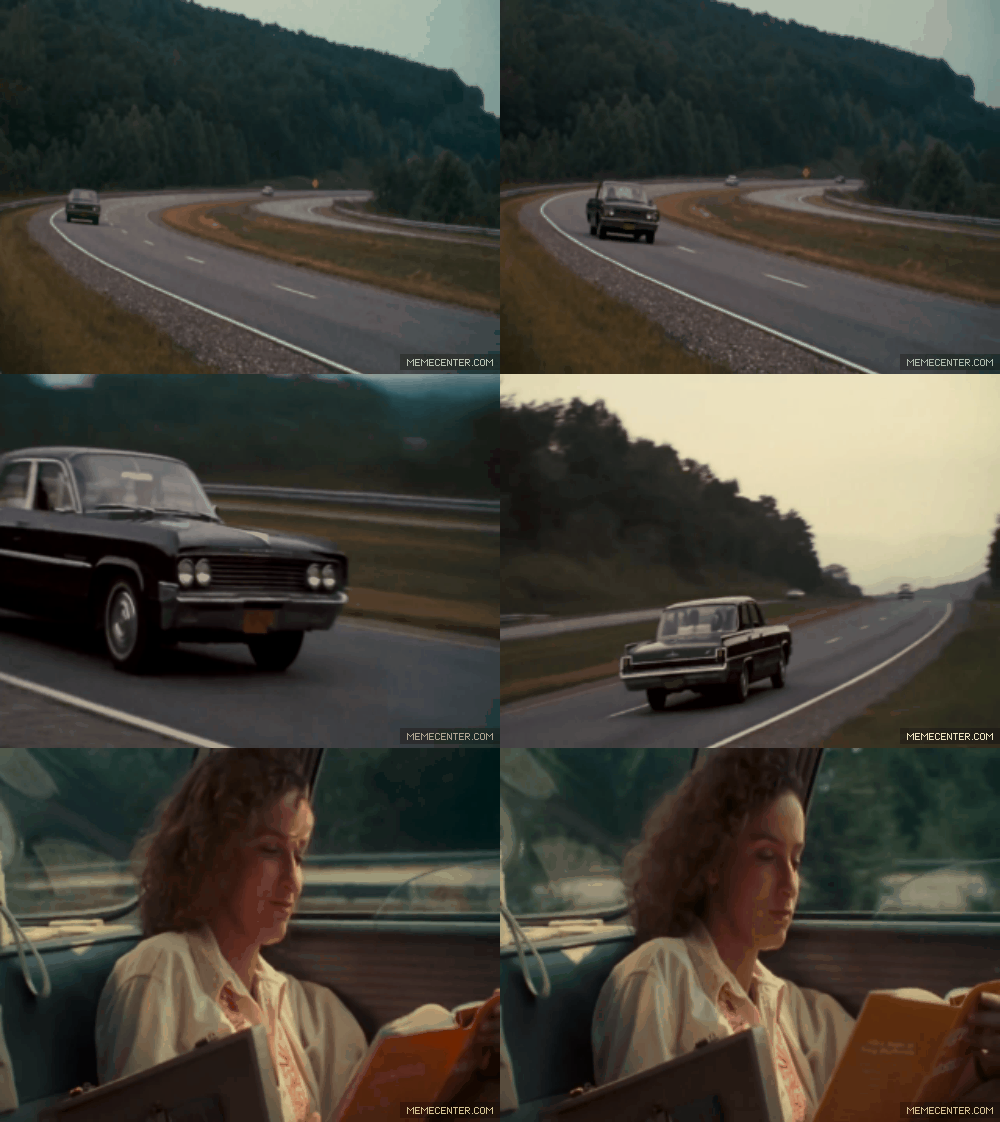
The first actual film footage you see after the opening montage is the car in which Baby travels in, and this shows the audience that the car is going to the location of where the films is set. The era is also established, by the make of the car being a typical 60's film, when cars were big and only rich people had cars, establishing also the class of the characters, and that Baby is a middle/upper class woman, raised in a wealthy family. The song playing as the scene is going revealing is 'Big Girls Don't Cry' by Frankie Valli and The Four Seasons in which the lyrics to the song are about how 'big girls don't cry' insinuating that Baby is a 'big girl' despite her nickname being Baby. The sound is diegetic and then goes to non-diegetic as the voice over of Baby kicks in. This song was popular in the sixties with the rock'n'roll music having it's day. This song also hints to the audience that Penny, the 'rockette' connoting she is a 'bad girl' who enjoys listening to rock & roll. Also in the 60's 'rocket/rockette' was slang for a drug user and people involved in drug culture, so further developing characters without even seeing him them yet. Penny's relationship with Johnny is distinct, as they are not in a romantic relationship, it is more of a 'back up', safety net friendship for the pair. This is the first view of Baby, and this is significant because she is the main character in the film, so it establishes key characters in the film. This proves Baby is one of the key characters in the film, as she is the first to be seen in the shot. The close up of her reading a book connotes a smart, independent woman, who is intelligent and knows what she wants in life. This can also signify and reinforce the era that the film is set in, as her clothing are typical of this period in history, being flouncy and free. Baby's clothing also connotes innocence and her being a typical daddy's girl, in which she dresses modestly, which is ironic as she goes on to become almost a grown up woman, as she dances sexually, and goes to the staff club, where she meets Johnny, in which the club is established in the opening sequence i have analysed above. The audience's first perception of Baby is young and innocent, which is twisted later in the film as she falls in love with Johnny. The voice over of Baby comes in at 0:02:00, in which she introduces herself, she says in this video that she wants to become a member of the peace corps, which establishes Baby as a selfless character, as she wants to help others, and travel the world helping others, so she is a caring and selfless character. The enigmatic questions are asked by the audience, asking 'Who is this girl?' and 'What is going to happen to her?', in which the story unfolds as she arrives at Kellerman's mountain resort. The themes in the scene are a culture clash, as Baby is established as a middle / upper class woman, and Johnny is working class. Also, aspiration is a theme, as it is explored through the voice over and how Baby talks about how successful she hopes her future to be.

0:02:35 - 0:02:43

This shot is an establishing shot of Kellerman's mountain resort, which establishes the first real setting and location where the film is going to be situated. This scene also relates back to the opening montage, telling the audience that the first location where the montage was held, was in Kellerman's resort, so by just 2 minutes 35, the audience have put all the clues and narrative together to define where the film will be located and what settings will be key to the film. The location of Kellerman's is seen to be a massive resort, which looks very much for rich and wealthy people to go to on vacation to which reinforces the class of Baby and her family. In the voice over, Baby says 'That was the summer we went to Kellerman's and then is silence, which creates an affect, which lets the audience see the resort for themselves and make their own judgement into what will happen in the next scene and the forthcoming film. The hand held camera movements could connote that Baby is filming the scene herself, as a type of memory video recorder, for family holiday video tape, or this shot could be purely Baby's vision of what she sees as she looks out of the car window. The setting is established on a summer day, in which the themes of Summer romance could come into it, as Baby and Johnny are together for a whole summer, and that is where the film ends, so by Baby saying in her voice over ''That was the summer we went to Kellerman's'', which sounds like a backtrack, and she is thinking back to one of the best summers she ever had as she is very informal as she speaks, so she is putting herself back into her 17 year old girl role, even though she would be older when she is speaking this voice over. The sound at this part of the film is continued to play as the 60's era car pulls up, reestablishing era, and the sound then becomes diegetic again and the Houseman family in the car can all hear it, as it is being played through the car radio. 

0:04:13 - 0:04:25

This scene introduces the owner of the summer resort, Max Kellerman. Who is the patient of Dr. Jake Houseman, Baby's father. This doctoral role reinforces the wealth and upper class nature of the Houseman family already established. Max's line of 'There's a merengue class in the gazebo in the next few minutes, The greatest teacher. Used to be a Rockette.' This line further establishes the dancing aspect of the film, and reassures the Houseman family that people can change, which then presumably foreshadows Johnny's relationship with Baby, and that 'bad boy' personas can then change into more respectable ones, and that they should not be too quick to judge their daughter's lifestyle choices and who she chooses to affiliate herself with. This scene is powerful in exploring other characters such as Max and briefly Penny, connoting these two are strong characters as they are explored in an insignificant detail which is ironic. By Penny being described as a former 'rockette' this connotes the tension between Johnny and Penny's relationship as they are not formally in a romantic relationship. By Max being the first on site member of staff greeting the Houseman family, this shoes he is a very rich and respectable man in the hospitality industry, as he has invited the family to his resort for the first time. Max's views are cast on the working class American citizens, as he frowns upon Penny's lifestyle habits before she became a dancer at the resort, which then the theme of Aspiration is re-enforced, as Penny's dream was to be a dancer since she was a child. The close up of each characters faces are reaction shots with establish emotion within the scene, as this is the Houseman's first family vacation in a long time, reinforcing the theme of hard work and success of Jake.  

0:05:19 - 00:05:29

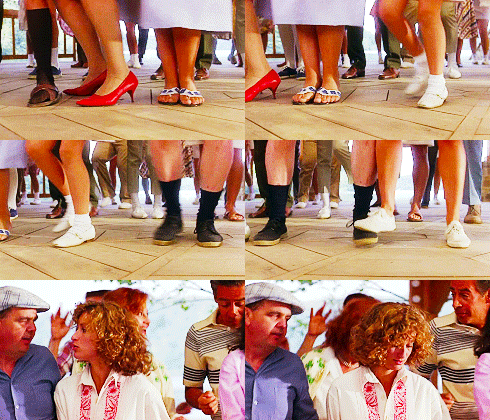
This scene explores the atmosphere of Kellerman's and the atmosphere the people at the summer camp have to dancing and how Baby feels very anxious and self conscious. The themes shown are innocence, as when Penny says, ''Okay now, ladies, when i say 'stop'... you're gonna find the man of your dreams...STOP!'' Baby goes to dance with her dad, showing how innocent Baby is, and she is a daddy's girl. Baby also says something like this in her voice over when she said ''...and I thought I'd never find a guy as great as my dad'', recapitulating that Baby is very close to her dad, and they have a close father and daughter bond. Even though Baby is a daddy's girl, and her daddy will protect her, deep down, Baby is shy and she has a sense of an uncomfortable state as she dances, connoting she is a shy and anxious character who keeps her self to herself, and when she meets Johnny, Baby changes in to woman and no longer a shy teenager. The long shots cover the whole of the dancing scene, which establish the setting, on the gazebo which plays an important location in the upcoming scenes. These long shots are also used as a way for the audience to spot Baby and Dr. Houseman during the scene, as they are the only characters we have visually been introduced to. Close ups of the feet of the holidaymakers as they are in Penny's dance class is an interesting shot, as we then see Baby step on someone elses feet, and get tangled up which connotes she  is a bad dancer, which asks enigmatic questions  to the audience such as 'why is the film situated around this character if she can't dance?'. Penny's introduction to the audience is very a very flirty and fiery character, in which the film goes on to explore her back story and how she struggles to cope with discovering she is an expectant mother. Penny covers up with a brave face, this is shown she is most likely a down trodden woman, who has had a hard life, and not the best start to life at all. The music in this scene is diegetic, so the characters within the story line can hear it, the piece of music is typical of the 60's, when dancing was a particular hobby for upper class people, and families that could afford to take lessons. 

00:06:38 - 00:06:48

The dark balcony that Baby is walking on has natural, low key lighting symbolizin

g it is night time at the summer camp. The fact that the balcony is dark connotes danger. The contrast between Baby walking on the balcony and Max Kellerman having a gathering with the waiting staff of the resort in the high key, artificial lighting, connotes the contradiction in the film, as innocent Baby is on the dark balcony, and the important staff are in the bright room where the conversation which doesn't sound very nice is currently undertaken. Max's personality is then contrasted as he is very bossy towards the staff and not very polite. This shows the audience that first impressions aren't everything in this film. The lighting for this scene plays a key contrast in the story line, that the visitors to the resort are kept in the dark, that the wait staff and the majority of the staff are under strict orders by Max to make sure they have the best time possible, and that the service they recieve is forced. I analyse this because Johnny and Baby's relationship is very natural, and not forced, which also breaks Max's rule of 'keep your hands off'. Risk is a theme explored in this film, as Johnny puts his career on the line as he develops his relationship with Baby. At 00:06:59, Johnny Castle enters for the first time, which completely changes the attitude and atmosphere of the scene. The costume Johnny is wearing is a tight fitting t shirt, a leather jacket over his shoulder and dark sunglasses, connoting he is a real bad boy, by the way he walks and the way he's dressed. Max gets frustrated that Johnny is walking late into the staff meeting and discusses dancing with Johnny in a raised tone of voice. This reinforces dancing as a theme, and this is also the first time that Baby finds out that Johnny is a dancer. This scene creates a real enigmatic vibe as the love at first sight aspect kicks in and questions are thrown to the audience, which include 'are they going to get together?' and the audience make judgments and assumptions into what's going to happen later in the film. 


00:07:56 - 00:08:03

This scene is of the Houseman's first family dinner at Kellerman's, which is set in the dining hall,  establishing another key setting of events in the film. This scene is particularly important as it establishes the class of the Houseman family and who Kellerman's caters for as its summer residents. The wait staff pull out the chairs for the guests connoting high class service, which connotes that the family are very well off. The props in this scene include a very well 'dressed' table with clean linen and posh decorations within the room, connoting classiness. In this scene baby is very distracted by the thoughts of Johnny who she saw in the last scene we can tell this because she is leaning back in her chair and she is very occupied with her  thoughts by staring off into space and not participating in the conversation being held by her fellow family members. Also in this scene we are introduced to Robbie who later in the film Lisa falls in love with, he is dressed in a smart shirt and tie as all of the wait staff at Kelllerman's are. Max mentions in this scene that Robbie is from Harvard university which is prestigious and he is of an upper social class fitting in with with his surroundings at Kellerman's. This scene also shows the audience that the Housemann family are tight knit and they are a very family holiday type family. So ethene of this film is family and relationships between father and daughter and a family in general. The first shot in this scene is a long shot which helps the audience to see the whole table and surrounding tables establishing class and setting amongst the whole scene and other characters staying at the resort. 

00:08:33 - 00:08:46

This scene is also sat in the Kellerman's resort dining room, and is a follow on from the scene analysed above. This scene introduces another new character, Neil, who is Max's grandson. Themes established in this scene are love and jealousy, as Neil is particularly interested in persuing a relationship with Baby. Social class also plays a big role in this scene, as Neil is looking to go to a top university, just as Baby wants to study in Mount Holy Oak connoting both of these characters are very smart and in control of their lives. Aspiration is a key theme, and I personally think the writers of this film have included this scene is to throw the audience off, by insinuating and hinting that Baby may be lots in her thoughts with Johnny but she is still possibly interested in Neil. Consequently leading the audience to question what will happen with Neil and Baby's relationship. One shot in the scene where there is a close up of Neil smiling at Baby and rasing his eyebrow, connotes he is a flirt, which at that point there is a cut to Baby's reaction of her smiling back.

00:18:24 - 00:18:34


In this scene, this is where Johnny and Baby have their first interaction in the film. The first shot is a midshot of the three characters, which sets up the conversation. As Johnny says the line, "Yo, Cuz, what's she doing here?", he looks at baby, and then back at his cousin. This connotes there is tension between the two, as Baby should not be in the club. This tension is established through the juxtaposition of the couple, which is to be much closer in the up coming scenes as Johnny changes his mind on his thoughts towards Baby. Baby is very innocent in this scene as the first thing she said to Johnny is 'I carried a watermelon', connoting she has never really had much experience in talking to men. The lighting in the club is very dim, which is natural, low key lighting connoting the mood and the reality of the dancing that is going on amongst the sexy dancers. Johnny's shirt is unbuttoned, creating the raunchy appeal of the dancing to the younger guests and staff members staying and working on the resort. Johnny is very strong, and he shows this when he beckons Baby over with his finger, telling her to come here. This also establishes the hold he has over her, which is a strong part of their relationship as it develops, and Johnny is a very dominating character, and Baby is innocent and shy. As Johnny teaches her to dance, Baby realises that this is her first true love, and possibly her first sexual experience, meaning that another theme in this film is sex. The song playing in this part of the film is Love Man by Otis Redding, which I'm assuming is put in to establish Johnny and how good he can be at loving women. 

Saturday, 1 November 2014

Commissioner Factfile


Powered by emaze

Conventions Of Institutional Credits

This Is England's opening sequence is full television archives from the 1980's. This can be scene in the first scene, where Roland Rat appears, who was a famous TV characterer. Lots of clips contain Margaret Thatcher, who was Prime Minister of England from 1979-1990, so throughout the 80's. There are clips showing her and Ronald Reagan, who she allied herself with during the cold war. Also, Britain's involvement with the Falklands war, Maggie played an involvment in. The Irish Republican Army tried to assassinate Thatcher, leading to more conflict in Northern Ireland and the 'troubles'. These archives are included in the opening sequence to hint to the audience that violence is a main theme throughout the film. Other connotations from the opening include Skinheads and Neo-Nazism and the National Front were big political groups in this era, connoting racism in the country, this is included in the opening sequence as the time was very racist and this hints to the audience that racism will play a big part in the storyline of the film. The location that the film is set looks like a council estate, seen at the title of the film, which were very popular in the 1980's because of Thatcher's whole 'buy your property' schemes, to allow homeowners more freedom. The opening sequence is one big connotation of the daily grind in 1980's Britain for every day working class families who lived under Thatcher's Conservative hold she had over the country. The song, '54-46 That's My Number' by Toots and The Maytals is reggae & ska sounding, which could connote there is going to be a charachter in the film who is of Jamaican decent.

There was no Instiution logo for the film so i chose to do the title


The fact that the title is set on a scene where it establishes the location that the film is going to be set is powerful, as the flats look very run down, and the grass is all overgrown. Connoting the resident familes do not reallty care what their living conditions are, just that they have a place to live is good enough. The typography is white, and bold in the centre of the screen, and it looks like it could be made to look like a stamp where not all the stamp is printed on the hypothetical paper. This could connote the run down lives the people lead in the film, and also connote stamps/pieces of papers giving by the job center/governmental departments when the characters collect their dole money or 'sign on' to the dole. This could prove that the people living in these council estate are poor and the majority are underclass people on the dole.
 

Timeline
00:05: contains the institution company name, film 4 and the UK film council which has probably funded the film, meaning that these are at the start because they are most important and without them, the film wouldn't have been created at all.

00:10: this gives credit to EM media and Screen Yorkshire for their involvement in the production, who obviously helped create the film, and provided equipment  and people for use of filming and post-production work.

00:15: Warp productions also have produced the film alongside the other production companies. Warp probably had less involvement in the making, but supported and helped along the way.

00:20: Big Arty productions may have taken a back seat, but also helped a long the way. This company is also owned by Shane Meadows which was cost effective for the film and also is a good way for the company to get noticed in the film industry and kick start its way into the industry.

00:23: Shane Meadows is the writer and director, and the fact that his name is mentioned in the very opening of the credits, connotes he is the most important crew member, and without him there would not be a storyline to the film, as it is based on his own personal experiences. This is HIS film, and nobody else's. 

00:35: THIS IS ENGLAND, the first time the title is mentioned/seen. This is positioned before the main actors, as it then helps the audience to establish what they've seen, and be able to relate the archive footage they've seen before the title.

00:42 - 01:05 (Each credit contains one actors name): this connotes these are the main actors in the film and have the most important roles., so therefore the audience can see if they know any actors in the film.

01:05-01:29 (Each credit contains two actors names): these credits connote these actors are important but have less screen time than the others. (e.g. someone's mum that's only seen in 2 scenes.)

01:29-02:06 (Each credit contains three actors names): these credits connote these actors are probably background characters but have at least one line of dialogue.

02:06 - 02:34 (Each credit contains 2 or 3 Film crew job titles): these credits connote these film crew are the less crucial jobs in the behind the scenes making of the film, but they are important enough to get credit for their work, as they do impact what the audience can visually see or hear.

02:34 director of photography: the director is important enough to get his own credit and is in charge of putting together all the camera and lighting equipment ready for filming, he gets credit because without cameras set up there would be no footage and the editor wouldn't be able to edit anything together, meaning they are next in sequence with each other because they need each other. danny cohen's other camerawork can be seen in les miserables and the kings speech. 

02:45 editor: the editor role is important enough to get his own credit, as he is the person who puts the film together and gives it a strong hold of continuity which creates the film the audience see. chris wyatt's other films include: shadow of the vampire and dead mans shoes.

02:53: line producer/co-producer & 03:01: executive producers: these producers help the main producer and this is why they are next to each other in the title sequence, they all work in the production grounds of the film making process and are delegated different roles by the main producer.

03:15 producer: the main man who makes sure the running of the film goes smoothly, and the second most important person in the film making process, after the director. 

03:25 written and directed by: the most important person in making a film, and the person who has most control, especially in this film as Shane Meadows wrote the film, based on his own life experiences, which means he was in control of every aspect and what he wanted he got. this title is at the end of the credits as it signifies the most important role.

FILM CREW ROLES in order of appearance after actors.
Script Supervisor - keeps track of what parts of the script have been filmed and makes notes of any changes between what was actually filmed and what appeared in the script. They make notes on every shot, and keep track of props, blocking, and other details to ensure continuity from shot to shot and scene to scene. The notes are given to the Editor to expedite the editing process. Works very closely with the Director on set. 
Casting Director - chooses the Actors for the characters of the film. This usually involves inviting potential Actors to read an excerpt from the script for an audition. 
Hair and Make-up Supervisor - The Hair Make-up Supervisor is a supporting position that normally reports to the Key Makeup Artist & Key Hair artist and to assist in running the makeup and hair department. They typically handle production matters and generally serve the needs of Senior Artists. Supervisors rarely do makeup themselves. Their duties can include keeping a record of makeup & hair continuity, handing the scheduling of makeup & hair teams and providing for the general needs of the makeup and hair department. They are expected to be a connection between the makeup & hair department and the rest of the production departments, making sure that makeup supplies, hair supplies, production assistants or electricians are on hand when needed.  
Costume Designer - The Costume Designer is responsible for all the clothing and costumes worn by all the actors that appear on screen. They are also responsible for designing, planning, and organising the construction of the garments down to the fabric, colours, and sizes. The Costume Designer works closely with the Director to understand and interpret "character", and interacts with the Production Designer. The Costume Designer will usually have one or more Assistant Costume Designers.  
Production Designer - The Production Designer is responsible for creating the visual appearance of the film - settings, costumes, character makeup, all taken as a unit. The Production Designer works closely with the Director and the Director of Photography to achieve the look of the film.  
Music Supervisor  - The Music Supervisor aka Music Director, works with the Composer, Mixers and Editors to create and integrate the film's music into the film.  
Director of Photography - The Director of Photography is the chief of the camera and lighting crew of the film. They make decisions on lighting and framing of shots in conjunction with the film's director. Typically, the Director tells the DoP how he or she wants a shot to look, and the DoP chooses the correct lens, filter, lighting and composition to achieve the desired aesthetic effect. The DoP is the senior creative crew member after the director.  
Film Editor - The Film Editor is the person who assembles the various shots into a coherent film, with the help of the Director. There are usually several Assistant Editors.  
Line Producer - The Line Producer is the liaison between the Studio or Producer and the Production Manager, responsible for managing the production budget. He or she is the person who is "on the line" on a day-to-day basis, and responsible for lining up the resources needed. 
Executive Producer - An Executive Producer is a producer who was not involved in the technical aspects of the film making process in the original definition, but has played a financial or creative role in ensuring that the project goes into production. 
Producer - A Film Producer creates the conditions for film making. The Producer initiates, coordinates, supervises, and controls matters such as raising funding, hiring key personnel, and arranging for distributors. The producer is involved throughout all phases of the film making process from development to completion of a project. Producers must be able to identify commercial, marketable projects. They need a keen business sense, and an intimate knowledge of all aspects of film production, financing, marketing and distribution. Producers are responsible for the overall quality control of productions.   
Writer - Creating characters, crafting dialogue and writing an engaging plot are all part of a scriptwriter’s job. Essentially, these creative dynamos form something which acts as the skeleton on which a director can map their creative vision. 
Director- The Director is responsible for overseeing the creative aspects of a film, including controlling the content and flow of the film's plot, directing the performances of Actors, organising and selecting the locations in which the film will be shot, and managing technical details such as the positioning of cameras, the use of lighting, and the timing and content of the film's soundtrack. 
(source:  http://en.wikipedia.org/wiki/Film_crew)


This opening sequence has helped me realise how many film crew roles there are to include in the opening sequence of a film, and how to order the importance of each job. This has helped me with timings of each individual credit, and how long they should have screen time for. Also, what production companies we should name, as this sequence did not contain Film 4's Logo, only their name, which can help me have a more professional looking sequence, as apposed to lots of irrelevant images.